Curatia Analysis for Fri, Nov 20
How Private Investment Funds Operate
 |
Jason Dibble
Editor-in-Chief |
Public markets represent the visible tip of a much larger investing iceberg with vast potential to buoy portfolios through high-growth equity stakes or income-generating private loans. Even so, access restrictions and information opacity have left private markets shrouded in mystery for many participants.
Understanding the lifecycle of private funds, how private investments unfold, how private assets are valued, and how they can meet diverse portfolio objectives can unlock superior outcomes for investors — not to mention a coveted career in private equity or venture capital for the motivated finance professional.
1. What are the stages in a private fund’s lifecycle?
Private investment funds employ a range of strategies. They may focus on a particular industry or region, target companies of a specific size or developmental stage, and seek either equity or credit in exchange for capital. Still, they generally follow a common blueprint over their lifecycle.
The familiar model is a closed-end drawdown fund, in which investors commit capital that the manager collects over time, with a planned date for winding down. Funds operate in distinct phases that may total a decade or longer. Phases may overlap, and their timing varies by strategy. Evergreen funds, which have no fixed end date, follow a different model.
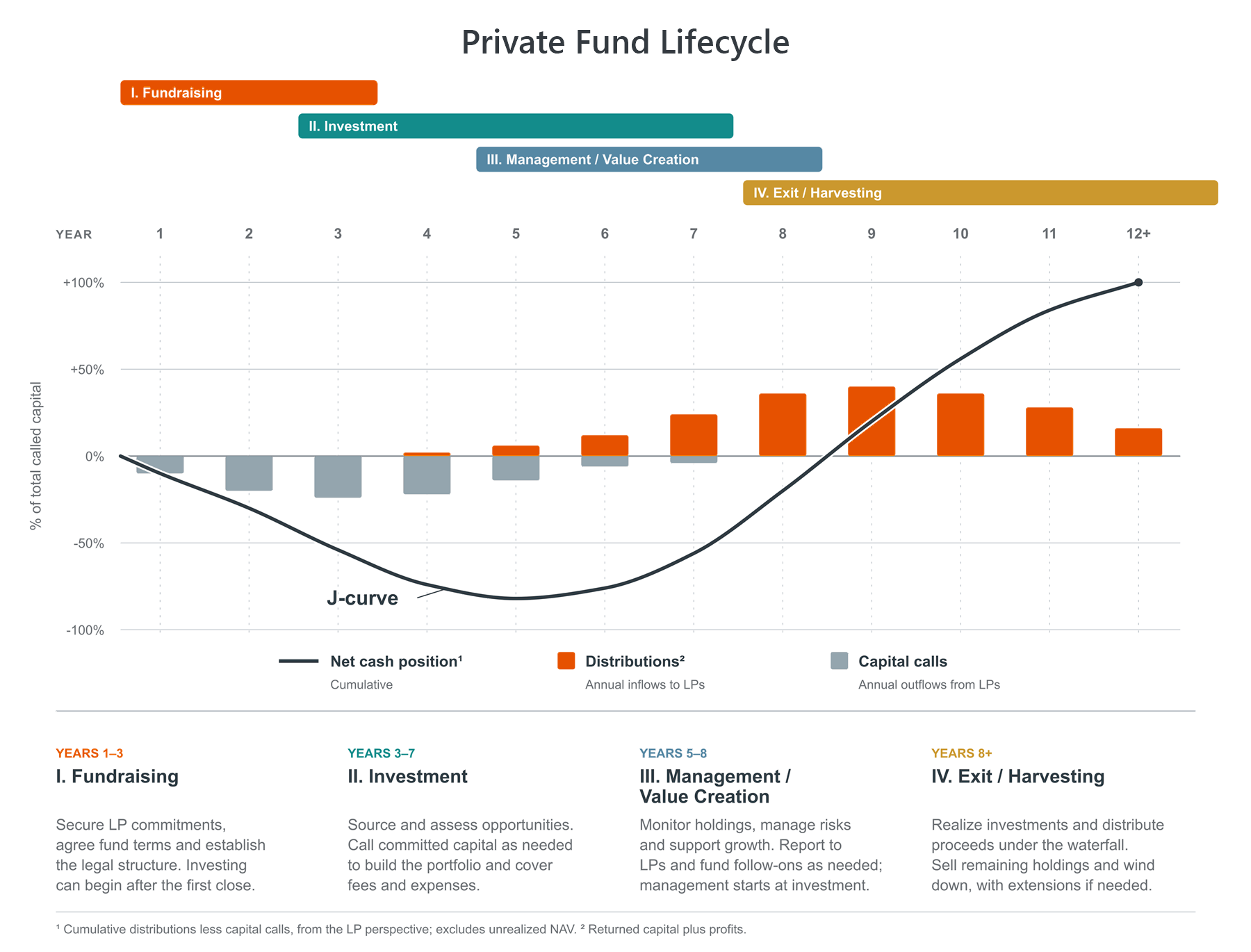
I. Fundraising Phase (Years 1-3)
Fundraising starts with the fund manager pitching its strategy, team, and track record to prospective investors. In a typical partnership, the general partner (GP) oversees the fund. Limited partners (LPs) supply capital and include pensions, endowments, sovereign wealth funds, insurers, family offices, and eligible individuals.
The parties establish the rules of their relationship through a limited partnership agreement (LPA). It sets out matters like investment restrictions, capital contributions, fees, profit sharing, and withdrawal rights. The management team also establishes the fund’s legal structure. An LP invests in the fund rather than directly owning each underlying company’s shares.
Investors formally join through one or more closings. After the first close, the manager can begin calling capital and making investments while continuing to raise money. Subsequent closings admit additional investors, often over roughly another year. The final close ends fundraising — not the fund’s operations.
II. Investment Phase (Years 3-7)
In the investing phase, the fund manager puts committed capital to work gradually, sourcing opportunities, conducting due diligence, and building a portfolio consistent with the fund’s strategy. Purchases are spread across time rather than concentrating at launch.
Investors generally don’t hand over their entire capital commitment upfront. Instead, the manager issues capital calls, requesting portions as investments and expenses require funding. Calls can also cover management fees, the manager’s ongoing compensation for running the fund. The LPA governs how and when capital calls occur.
For example, an LP making a hypothetical $1 million commitment might initially receive a $200k capital call. The remaining $800k is still an obligation, so the investor needs a plan for meeting later requests.
A fund’s vintage year identifies its starting year based on its first capital call, investment, or close (depending on the reporting convention). Comparing funds of the same vintage and strategy helps LPs assess performance against peers of similar maturity that invested under comparable economic conditions.
That matters because, depending on whether a fund launches at the top or bottom of an economic cycle, the companies in which it invests may have fetched higher or lower valuations at the time of investment. By spreading investments over several years, LPs can smooth out bumpiness in a fund’s returns caused by economic cyclicality.
III. Management / Value Creation Phase (Years 5-8)
Portfolio management begins with the first investment and continues while the fund holds assets. As the fund’s portfolio fills out, attention increasingly shifts to monitoring performance, managing risks, and helping investments develop. A buyout manager might support operational improvements or strengthen leadership teams. LPs, meanwhile, receive periodic reports — commonly quarterly — on the portfolio’s progress.
Reports track net asset value (NAV), the estimated value of the fund’s assets minus its liabilities, alongside performance measures. These can include internal rate of return (IRR), which reflects the timing of investment cash flows, and multiple on invested capital (MOIC), which compares the value generated with the amount invested. Results remain estimates until holdings are sold.
The manager may also reserve capital for follow-on investments in companies already in the fund’s portfolio. Ending the period for new investments doesn’t necessarily end capital calls or additional funding for existing holdings.
Early expenses can depress net returns before investments have generated enough gains to offset them. If those investments succeed, returns can improve over time, creating a pattern known as a J-curve.
IV. Harvesting / Exit Phase (Years 8+)
As the fund matures, its manager increasingly focuses on harvesting, turning investments into proceeds that can be returned to investors. For equity holdings, that can involve sales to corporate buyers or other investment funds, or selling shares through and after a public listing. Exits occur investment by investment rather than on one common deadline.
Distributions return cash or sometimes securities to investors. They can begin before the investment period ends, including when early holdings are sold or investments generate income. A fund can therefore be returning money from one investment while calling capital for another.
A distribution waterfall specifies how proceeds are allocated. Depending on the agreement, investors receive capital back and any specified preferred return before the GP receives carried interest, its contractual share of profits. Some arrangements calculate these allocations across the whole fund; others operate deal by deal. A preferred return establishes a payment hierarchy rather than guaranteeing profits.
Eventually, the fund disposes of remaining holdings, makes final distributions, and winds down. That process may require an extension to prevent a hurried sale. Extensions typically range from one to two years.
2. How does a private fund’s investment in a business unfold?
A private fund’s investment in a business progresses from finding and evaluating an opportunity to negotiating terms, providing funding, overseeing the investment, and eventually exiting. The fund manager leads that process, but its decisions depend on whether the fund is executing a buyout, taking a minority ownership stake, or making a loan.
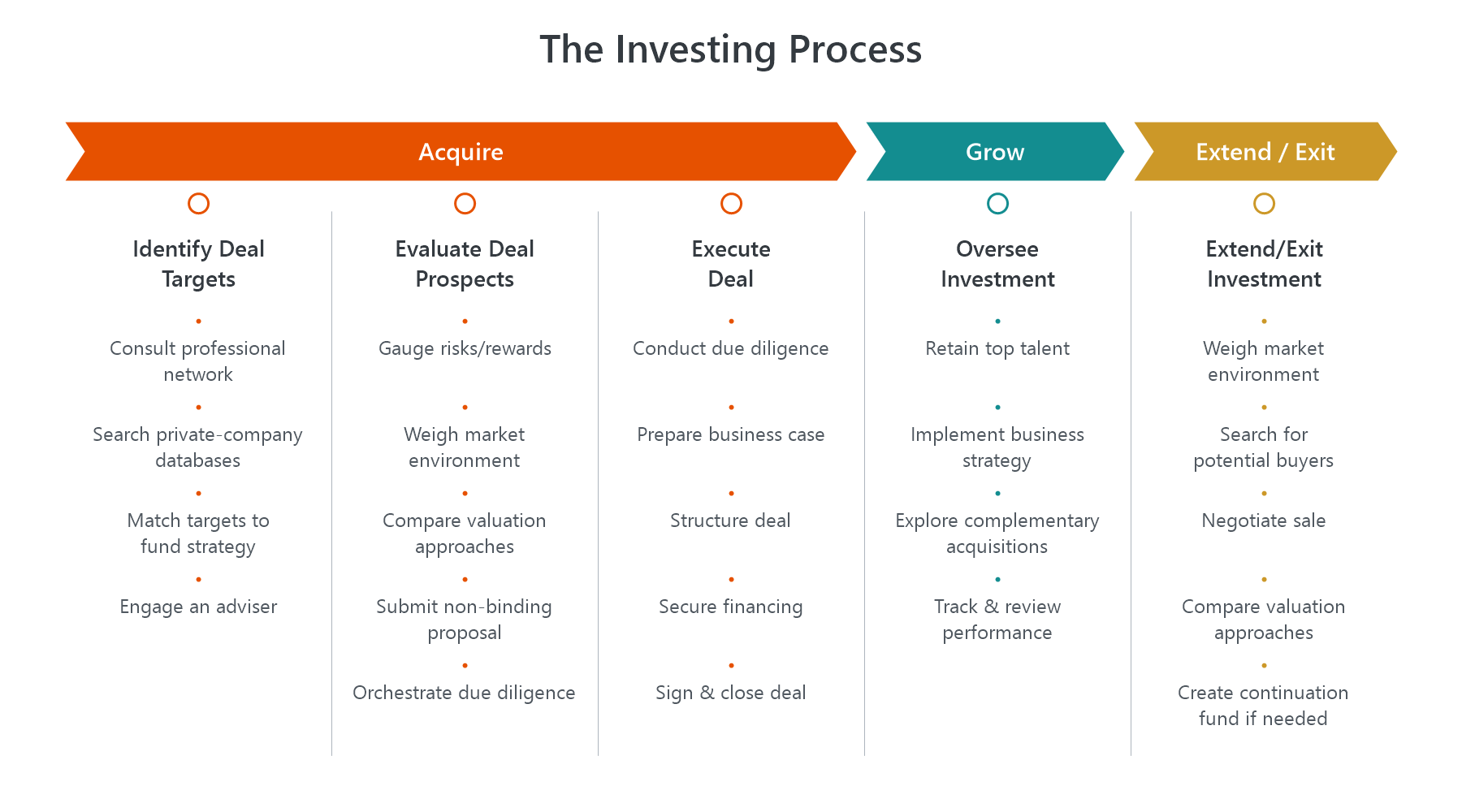
I. Identify & Evaluate Deal Targets
Fund managers’ investment teams look for businesses that fit their funds’ strategies. They approach founders and executives, draw on professional relationships, and consider introductions from other investors or advisers. A VC team, for example, might hear about a promising startup through an entrepreneur it previously backed.
Intermediaries can work for either side. A business owner may hire an investment bank or broker to find a buyer, with the seller paying the adviser’s fees. Or a fund manager may engage its own adviser to identify acquisition targets.
Fund managers or their proxies can also search extensive databases of private companies on financial-data platforms like the Bloomberg Terminal for investing targets.
Once a fund manager has identified an investment target, the fund’s deal team conducts due diligence, investigating its finances, customers, leadership, operations, and legal obligations. Lawyers, accountants, and industry specialists may assist. The team then presents its findings to the investment committee at the fund-management firm, which evaluates the proposed investment and decides whether to approve it.
II. Negotiate & Fund the Investment
The investment’s structure determines what the fund manager needs to negotiate. In a PE buyout, the fund typically negotiates a price at which to acquire a controlling stake, often combining its equity contribution with deal debt. The fund manager must assess both the business’s potential for improvement and its ability to support that borrowing through its future cash flows.
A VC fund, by contrast, typically takes a minority stake rather than buying the business outright. Its fund manager negotiates the investment’s price and shareholder rights, potentially including access to financial information, one or more board seats, and approval rights over certain major decisions. Those protections can provide influence without majority ownership.
For a private loan, the fund manager instead negotiates interest, repayment dates, seniority level relative to the company’s other debts, and protections against losses. These may include collateral, assets pledged to secure repayment, and covenants, contractual requirements such as limits on additional borrowing. The fund becomes a creditor to the business rather than necessarily acquiring an ownership stake in it.
The fund manager may also invite some of the fund’s LPs to make a co-investment, a separate investment in the same business alongside the main fund. Co-investors gain additional exposure to that individual business beyond their investment in the fund. Co-investing is a privilege that fund managers often offer to large and/or strategic LPs.
Once approvals and other closing conditions are satisfied, documents are signed and money changes hands. A business in which the fund holds an investment becomes a portfolio company.
III. Oversee the Investment
After closing, the fund manager’s attention shifts to implementing the fund’s plans and tracking the investment’s progress over time. Fund managers review performance, update valuations, and report to their investors. Their involvement in the portfolio company itself depends on the rights they negotiated and the type of investment they made.
VC fund managers may advise portfolio companies formally through a board representative. They may also consult informally with founders about hiring, strategy, fundraising, or potential customers. That advice supplements the work of the company’s executives, who remain responsible for running the business.
With a controlling interest in a business, PE fund managers often have greater scope to reshape operations. They may deploy dedicated operating teams alongside the portfolio company’s executives to improve technology, streamline processes, or strengthen leadership.
They may also seek to acquire businesses complementary to that of the portfolio company via the same fund to build value by exploiting synergies between the businesses — a strategy known as a buy-and-build or add-on acquisition model.
Private-credit fund managers generally focus on the borrower’s financial health and compliance with the loan agreement. They monitor cash flows and covenant requirements, maintain contact with company executives, and may negotiate changes if difficulties arise. Since they lack an equity stake in the portfolio company, their chief concern is ensuring loan repayment.
IV. Exit the Investment
Eventually, the fund manager seeks to turn the investment back into cash. A PE fund might sell its controlling stake to a corporate buyer or another fund. A VC fund might sell its minority stake when the business is acquired or sell shares during or after an IPO.
A lending fund normally receives interest over the loan’s life and recovers principal through repayment, potentially when the borrower refinances with another lender. It can also seek to sell the loan before repayment. Whether the fund recovers its money in full depends on the borrower’s performance and the value of its contractual protections.
Sales of existing investments take place in the secondary market. They can transfer company shares, loans, or entire portfolios. A separate type of secondary transaction occurs when an LP sells its interest in a fund. That changes who participates in the fund rather than the fund’s ownership of its portfolio companies.
V. Extend the Investment
Sometimes a fund is approaching the end of its life, but the fund manager believes a portfolio company would benefit from more time or additional capital. Some LPs may want their money back, while others prefer to remain invested. In those circumstances, the fund manager may propose a GP-led continuation fund, a new fund that buys one or more investments from the original fund.
The same fund manager oversees the new vehicle. Incoming investors help finance the purchase, while existing LPs are generally offered a choice between selling and continuing their investment. This can reconcile different investors’ time horizons, but it also creates conflicts, because the fund manager acts for both the selling and buying funds. Pricing, fees, and investors’ options therefore warrant particular scrutiny.
Whichever exit route the fund manager pursues, finding a buyer is only part of the process. Confidentiality, buyer eligibility, company approvals, and contractual transfer restrictions can delay or prevent a sale. The terms negotiated when an investment begins help determine how — and to whom — it can eventually be sold.
3. How do investors determine the value of private funds and their portfolio companies?
When a fund or company is publicly traded, its share price provides a real-time window into investors’ collective view of its value. Private-share trading platforms offer pricing signals for some private companies, but trading is less frequent and coverage uneven. In most cases, investors must turn to other methods to value private funds and their portfolio companies — each with its own strengths and limitations.
Below are some of the most common. We’ll start with portfolio companies, since the value of a fund’s investments in those businesses provides the foundation for valuing the fund itself.
The Most Recent Financing Round
A company’s latest financing round gives fund managers a concrete valuation baseline: the price investors actually paid for newly issued shares. That evidence can be especially useful for a startup with limited financial history.
A recent investment by independent investors offers a stronger reference point than an older transaction whose price may no longer reflect the company’s performance or market conditions. In either case, investors must factor in changes that have materially impacted the business’s valuation since the last financing round.
Fund managers also need to examine what prior investors received. Newly issued shares may carry protections earlier shares lack, such as priority in receiving proceeds when the company is sold. Applying the latest share price to every share can therefore overstate the company’s value and misrepresent what the fund’s stake is worth.
Public Comparables
Another approach looks at how public markets value similar businesses. Fund managers identify public comparables, or listed companies with similar products, customers, and financial characteristics. They then examine comparable companies’ valuation multiples, which express value relative to a financial measure like revenue or earnings, and apply an appropriate multiple to the private company.
For example, suppose comparable companies’ operations are valued at four times annual revenue. Applying that multiple to a private company with $25 million in revenue suggests a $100 million enterprise value, which values the entire business (including debt, cash, and preferred stock) rather than just its equity. That’s an illustrative starting estimate, before adjustments for differences between the businesses.
The advantage of public comps is access to regularly updated prices and financial disclosures. The difficulty is finding genuinely comparable companies. A smaller private business may grow faster, depend on fewer customers, or be harder to sell than public peers. Fund managers must account for those differences rather than simply copying the public-market multiple.
Transaction Multiples
Fund managers can also value a portfolio company by examining what buyers paid to acquire similar businesses. Using transaction multiples, they compare acquisition prices with the acquired companies’ revenue or earnings, then apply relevant ratios to the portfolio company. This approach grounds the estimate in completed deals and can be especially useful when considering the potential sale of a controlling stake.
The limitation of this approach is that yesterday’s acquisition price may reflect circumstances that don’t apply today. Market conditions may have changed, or the buyer may have paid extra to obtain control.
Private deals also frequently disclose too little financial information to support a reliable comparison. For VC investors, a price paid for an entire business may be a poor guide to a minority stake.
Projected Cash Flows
Rather than relying primarily on what investors paid for other businesses, fund managers can estimate what the portfolio company itself will generate. A discounted cash flow (DCF) analysis projects a business’s future cash flows and translates them into a present value, accounting for the time until the money arrives and the uncertainty surrounding those forecasts.
The approach can reflect a company’s particular circumstances, including planned expansion, improving profitability, or substantial investment needs. It’s especially helpful when close comparables are scarce. A typical model also includes a terminal value, an estimate of the business’s value beyond the period covered by the detailed forecast.
That flexibility comes with considerable judgment. A DCF analysis is sensitive to changes in projected growth, costs, the rate at which future cash flows are discounted, and terminal value. Forecasting is particularly difficult for a young business whose long-term economics remain uncertain. Fund managers therefore need to test different assumptions and assess whether other valuation evidence supports the outcome.
From Company Values to Fund NAV
To translate portfolio-company valuations into fund NAV, fund managers must adjust for cash, debt, and other claims to arrive at the value available to shareholders. They must also consider the fund’s ownership percentage and the rights attached to its shares.
Holding-level estimates then feed into the fund’s NAV, alongside cash and other assets and adjustments for fund-level borrowing and accrued expenses.
Since private investments are revalued periodically rather than continuously, NAV corresponds to a specific reporting date. A subsequent financing round, acquisition offer, or change in company performance may alter the picture before the next report arrives.
4. How do investors use private assets to meet diverse portfolio objectives?
Private assets give investors access to opportunities that may be difficult to capture through public markets alone such as exposure to businesses and stages of growth missing from public portfolios. They can help investors protect against some risks, generate income, or pursue higher returns.
Hedging
Hedging means using an investment to offset a risk elsewhere in a portfolio. Private assets are generally better suited to hedging long-term economic risks than short-term market events, since they can take time to buy and sell.
Real estate offers a useful example. Properties can generate rental income that rises over time, and some leases explicitly provide for inflation-linked rent increases.
Illiquidity can also indirectly benefit investors with long investing horizons. Because private holdings aren’t continuously traded, investors are less exposed to day-to-day market pricing and are less able to react impulsively to temporary volatility.
Generating Income
For investors interested in receiving regular payments, private assets can provide cash flows with varying degrees of predictability.
Private credit sits toward the more consistent end of that spectrum. Direct loans typically require borrowers to make regular interest payments, often at floating rates, giving investors a contractual source of income for the loan’s duration, provided the borrower remains able to pay.
Private real estate can also generate recurring income through rents. But those cash flows depend more on operating conditions. Vacancies, tenant defaults, lease expirations, maintenance costs, and local property markets can all impact the cash flow a property generates. Long leases can make income relatively stable, while properties with frequent tenant turnover may be less predictable.
Natural-resource investments can sit much further out on the risk spectrum. An investment in an oil well, for example, may generate substantial cash when production is strong and oil prices are high. Its income can fall sharply if production dwindles, commodity prices decline, or operational complications arise, however.
Speculation
Private assets can also unlock substantial capital appreciation. That is particularly true as more fast-growing startups stay private for longer, leaving individual investors fewer opportunities to realize the sorts of exponential gains often associated with startup stakes in public markets.
In exchange for access to fast-growing private companies, investors accept illiquidity, long investing horizons, uncertain valuations, and the possibility of significant losses.
Venture capital is by nature speculative. A fund may back numerous young companies knowing that some will fail while hoping that a small number of exceptional investments generate enough gains to drive the portfolio’s overall return.
PE buyouts generally target more mature businesses with sufficient cash flows to pay down the debt that financed the deal. But investors are still betting that financial restructuring, operational improvements, and growth will enhance those companies’ value before they are sold.
Other private assets can support similarly aggressive strategies. Investors might finance distressed businesses, develop property in an unproven market, or invest in natural-resource projects whose returns depend heavily on operational risks and future commodity prices. The potential reward rises because the outcome is less certain.
Illiquidity changes the nature of that speculation. An investor who correctly anticipates a company’s growth may still have to wait years for an acquisition, IPO, or secondary sale before realizing the gain.